Modern Intake Flow: Anonymous Visitor to Paying Client
Most law firm websites lose 80%+ of their visitors at intake. The flow is wrong: a long contact form, a slow first response, no language coverage, no qualification before a human is paged. Visitors who came ready to engage bounce to a competitor who made it easier.
This article is the conversion-design version. For the operational template setup see Intake Templates.
Where the funnel actually breaks
| Step | Common breakage |
|---|---|
| Visitor arrives | Bounce because there's no clear "talk now" option. |
| Visitor opens chat | Scripted bot demands a name before saying anything useful. |
| Visitor describes situation | Form treats their answer as a single field; no follow-ups. |
| Visitor reaches contact ask | Form requires too much; they bail. |
| Submission arrives | Goes to a generic inbox, no SLA, hours pass. |
| First firm response | Generic reply that doesn't acknowledge their situation. |
| Consultation booking | Email back-and-forth to find a slot. |
Each row is a conversion drop. Fix one, lift the funnel a little; fix all of them, the firm's intake becomes a real revenue surface.
The four-stage flow Blawby runs
Stage 1 — Anonymous engagement (first 0–2 minutes)
Goal: provide value, establish credibility, don't ask for anything yet.
The AI's first turn:
I can help you understand whether our firm can help. Tell me what happened.
No name field. No phone request. The visitor types a sentence; the AI responds with relevant context (sympathy where appropriate, jurisdiction-aware framing, plain-language clarification). They've engaged before any "personal info" boundary was crossed.
Stage 2 — Trust building (2–5 minutes)
Goal: show domain knowledge by asking the right follow-ups.
The AI uses your template's required fields to drive structured follow-up: matter type, brief case summary, jurisdiction, urgency. Each question is asked one at a time, with conditional logic via dependsOn so irrelevant questions never appear:
- key: court_date
  label: "When is your next court date?"
  type: date
  dependsOn:
    field: has_open_case
    value: true
The visitor experiences competence: the AI is asking the questions a paralegal would ask, in the right order.
Stage 3 — Qualification (5–8 minutes)
Goal: confirm fit, surface deal-breakers (jurisdiction, conflict, urgency mismatch).
The AI asks any remaining required fields and starts noting urgency. If your services list excludes the matter type, the AI surfaces that politely without forcing the visitor to discover it via decline.
Stage 4 — Authentication and (optionally) payment
Goal: collect contact info; if your policy is paid consults, collect the fee.
Now the AI asks for name, email, and phone. The framing matters: "What's the best way to reach you so an attorney can review this and follow up?" — not "Please provide your contact information for our records."
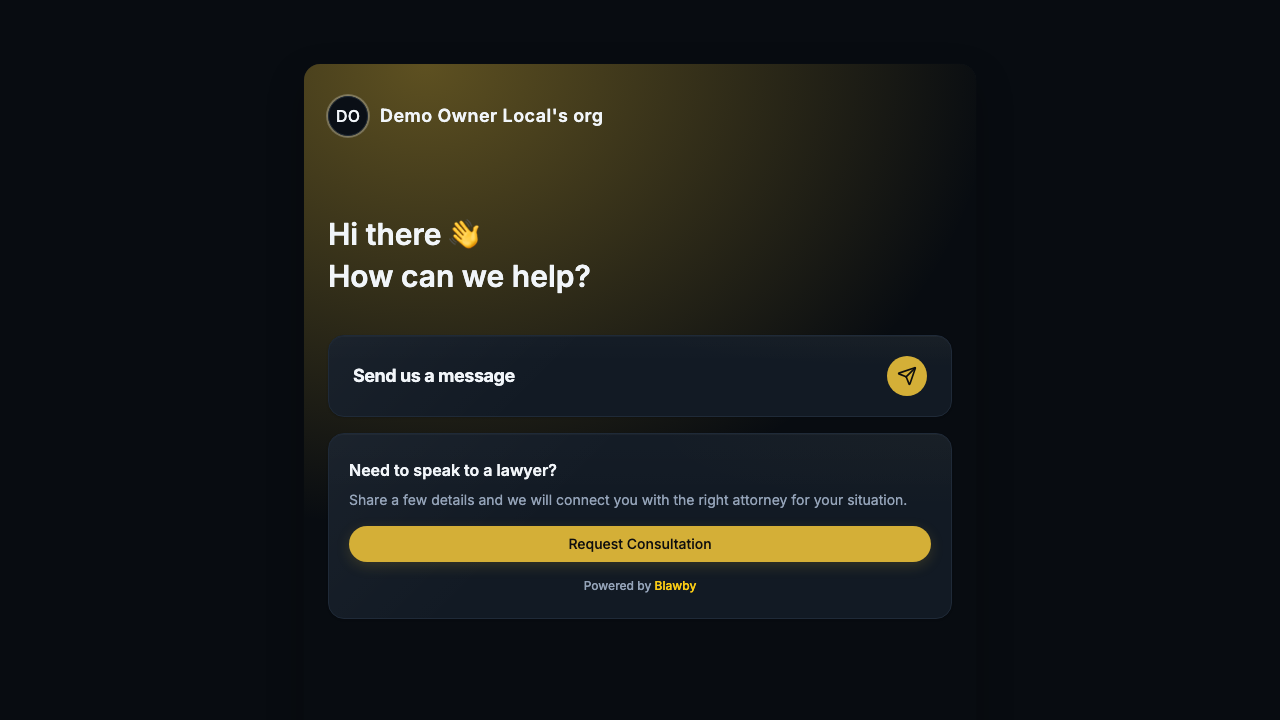
If your template has a consultation fee, the Stripe payment card renders inline in the chat thread between contact collection and submission confirmation. The visitor pays without leaving the conversation.
Why required vs. enrichment fields matter
The single highest-leverage decision in template design: which fields gate submission, and which become "strengthen your case" enrichment.
Required fields must be filled before submission. Each one is a drop-off risk. Keep this list to ≤5 — typically: contact, matter type, case summary, jurisdiction, urgency.
Enrichment fields are offered after submission. The visitor has already crossed the conversion line; now they're being asked to upgrade the case quality. Drop-off here doesn't lose the lead — you still have the submission.
This is the structural insight most generic chatbots miss. They either gate everything (kills conversion) or gate nothing (lands sparse leads). Blawby's two-phase model lets you collect rich case context after the lead is captured.
Session continuity
A potential client often pauses mid-intake. They get distracted, switch devices, or just need a minute. If they return, the conversation picks up where it left off — the prior exchanges, the partial answers, all preserved.
This is what makes the four-stage flow practical. Without continuity, every interruption is a lost lead.
Multilingual: the lever most firms ignore
If your client base is anything other than English-only, multilingual intake is the highest-impact change you can make. Blawby runs intake in 18 languages with full RTL for Arabic. The widget detects browser language; clients can switch.
For firms serving immigrant communities, the math is straightforward: the leads who bounced because they couldn't read the English form weren't bad leads — they were leads you couldn't reach.
Performance metrics worth tracking
Don't track everything. Track these monthly:
- Conversation start rate — visitors who send a first message.
- Required-fields completion rate — % of started intakes that submit.
- Submission-to-accept rate — your triage decisions.
- Accept-to-paid rate — full conversion through engagement and first payment.
- Median time to first response — your firm's SLA on the queue.
If completion rate is low, drop a required field. If accept rate is low, refine your template's qualification questions or your services list. If accept-to-paid is low, look at engagement timing — sending the engagement same-day beats sending it next week.
Practical patterns that work
- Write the disclaimer once, leave it on. Pre-collection disclaimer is a trust signal, not a friction point.
- Use conditional fields aggressively. Visitors notice when a chat asks the right next question, and notice when it asks five irrelevant ones.
- Send the engagement same-day for any matter you accept. Momentum compounds.
- Never disable session continuity. Lead-recovery on resumed sessions is a non-trivial percentage.
Where this leaves your team
When intake is set up well, your queue fills with submissions that have:
- Confirmed jurisdiction.
- Categorized matter type.
- Urgency level.
- AI-generated short-form case summary.
- Documents the client uploaded inline.
- Paid consultation fee (if your policy).
- Optional enrichment context to strengthen the case.
The first response no longer starts cold. The attorney walks into the consult with a much fuller picture, and conversion rates compound.
Next steps
- Build your template: Intake Templates.
- Wire up your widget: Install the Chat Widget.
- Set your triage policy: Review and Triage Client Intakes.
Ready to convert more visitors into paying clients? Start your setup.